
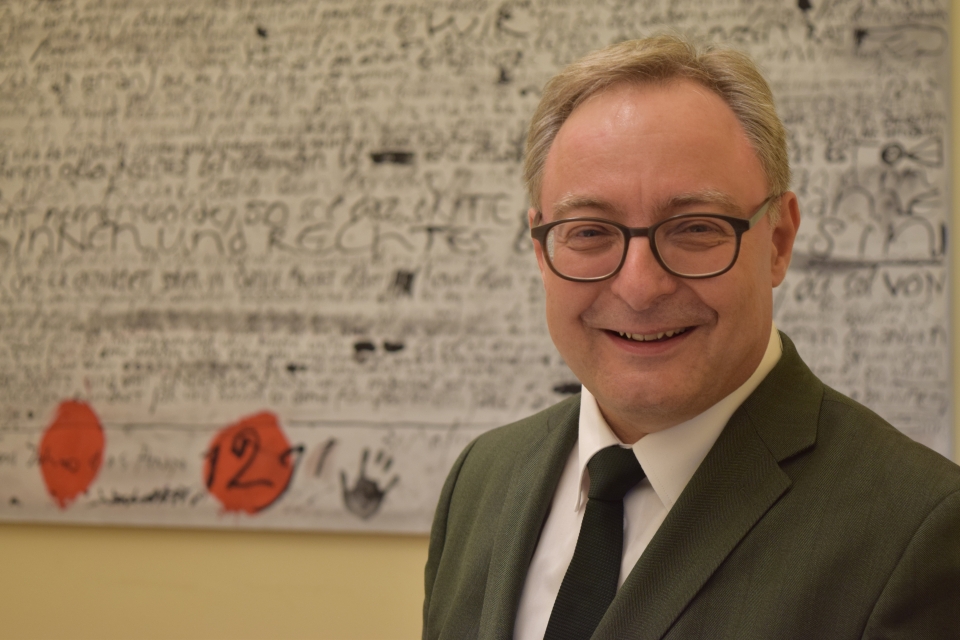
Sacha Zala was elected President on 27 August 2026
Address
CISH has a remarkable long history, a strong international network, and an important mission.
At the same time, we live in a world that is changing rapidly. International cooperation is becoming more complex, expectations are increasing, and decisions often need to be taken more quickly than in the past.
In many countries, history is under attack, academic freedom is being threatened, research funding is being cut, archives are restricting access to sources, and history courses in schools are being reduced or even scrapped altogether.
With the adoption of the new CISH Constitution in August 2026, I am confident that we have laid the institutional foundations needed to meet these challenges.
Acceptance Speech by the New President, Sacha Zala
«Très ému par l’élection au poste de Président du Comité international des sciences historiques, et très honoré par la charge qui m’incombe […], je me permets tout d’abord de remercier […] l’assemblée générale pour cette preuve de confiance qui elle a bien voulu me témoigner.»
Dear colleagues, dear friends
With these words, Aleksander Gieysztor accepted his election to the presidency of CISH in Bucharest on 17 August 1980. His address is reproduced as document 32 in our new documentary edition on the history of CISH (dodis.ch/75263).
Today, I would like to make his words my own.
First and foremost, allow me to thank you sincerely for the confidence you have placed in me. In academia, we are used to asking difficult questions. Today, however, I find myself confronted with perhaps the most difficult question of all:
«Why did I run for this job?»
But I will do my very best not to ask myself that question too often. I am sure that my partner Andrea, who has accompanied me to the CISH Congress since Oslo in the year 2000, will be happy to ask it for me — probably once a week.
To be elected President of CISH is a profound honour, and I accept this responsibility with no illusions about its demands. My experience as CISH Treasurer, combined with twelve years as President of a major National Committee and service as President of an Affiliated International Organisation, has occasionally called for a certain degree of intellectual acrobatics. Yet these different roles have allowed me to understand from within the interests, expectations, and distinct perspectives at each of these three different dimensions. One of my central responsibilities as President will be to bring them together — to respect their differences, identify common ground, and align their interests in the service of CISH as a whole.
Our association has a remarkable long history, a strong international network, and an important mission.
At the same time, we live in a world that is changing rapidly. International cooperation is becoming more complex, expectations are increasing, and decisions often need to be taken more quickly than in the past. In many countries, history is under attack, academic freedom is being threatened, research funding is being cut, archives are restricting access to sources, and history courses in schools are being reduced or even scrapped altogether.
With the adoption of the new Constitution, I am confident that we have laid the institutional foundations needed to meet these challenges.
I would also like to express my sincere gratitude to the colleagues — and friends — who carried this reform forward through two years of intensive, at times demanding, but always constructive discussions about the future of CISH.
I thank our outgoing President, Catherine Horel, and our Secretary-General, Edoardo Tortarolo, for giving me the institutional space to develop this initiative and for enabling the reform process to advance in an open and constructive spirit.
Our two Vice-Presidents deserve particular recognition. Eliana Dutra has worked tirelessly to expand and strengthen CISH’s networks across Latin America, bringing new institutions, scholarly communities, and perspectives more closely into our common work. Krzysztof Makowski faced the extraordinary task of guiding the XXIII International Congress of Historical Sciences in Poznań through the uncertainty, postponements, and disruption caused by the pandemic. Under exceptionally difficult circumstances, he and his colleagues ultimately delivered a highly successful congress of lasting significance.
I extend my heartfelt thanks to Gunlög Fur, Hirotaka Watanabe, Joel Harrington, and Nuno Gonçalo Monteiro. Each brought a distinctive perspective, intellectual generosity, and invaluable experience to our discussions, helping to transform an ambitious idea into a viable constitutional framework.
I am particularly pleased that Matthias Middell and Katalin Szende will continue to serve on the new Board. I very much look forward to continuing our work together and benefiting from their considerable knowledge and experience.
I also warmly welcome the new members of the Board. Together, we will work to make CISH more open, more inclusive, and better equipped to meet the challenges of its second century. I am particularly proud that, for the first time in CISH’s history, women constitute a majority of the Board.
Finally, I wish to thank our Deputy Secretary-General, Flavio Eichmann, for the efficient and indispensable work he has carried out through our newly established Office in Bern throughout this process.
This reform is the product of collective reflection, mutual trust, and a shared determination to prepare CISH for its second century. I am immensely proud — and profoundly grateful — that, together, we have made it possible.
We should now focus on four priorities:
- first, the professionalisation of CISH to make it more efficient and agile;
- second, strengthening cooperation among our members, in particular by reinforcing ties with our National Organisations and deepening collaboration with our Affiliated International Organisations;
- third, further developing the organisation of international congresses, making them more dynamic, financially sustainable, and attractive to the worldwide historical community;
- and fourth, to become more visible and vocal wherever history and academic freedom are under attack, while remaining true to our diplomatic tradition of building an «Oecumene of Historians».
Now that you have entrusted the new Board and me with this responsibility, there will be little time for celebration — and even less for a honeymoon. The task before us is considerable, and our work must begin at once.
I am under no illusion that any President could accomplish it alone. This presidency can succeed only through close cooperation among the Board, the Office, and the member organisations that form the foundation of CISH.
I accept this charge with humility, determination, and enthusiasm. I am fully conscious of the demands it will place upon us in the years ahead. Yet I am equally confident that, together, we possess the knowledge, experience, and energy required to meet them — and to ensure that the CISH we cherish is ready to enter its second century.
Next spring, less than a year from now, we will meet online for our next General Assembly — the first to convene under our new Constitution. When we meet, the new Board and I intend to report not merely on plans, but on tangible results worthy of your trust.
Thank you once again for the confidence you placed in the constructive process that led to the adoption of our new Constitution, and for the trust you have now placed in the new Board. We shall do everything in our power to prove worthy of it.
Merci! Herzlichen Dank!
Closing Speech by the New President, Sacha Zala
«Es gilt einander in seinen besten Gütern und Kräften erst kennen zu lernen. Dann wird die gegenseitige Achtung und damit die Harmonie des Ganzen von selbst sich nicht nur herstellen sondern auch festigen.»
Dear colleagues, dear friends,
With these words «We must first come to know one another through the finest qualities and strengths each of us has to offer», spoken at the first CISH General Assembly in Göttingen in 1927, Hermann Thiersch gave expression to an ideal that has taken on vivid form here in Leipzig. Over the past few days, we have had the privilege of coming to know both this city and our hosts through the very best they have to offer.
At that first General Assembly, Thiersch also articulated an aspiration that would help guide CISH throughout its history:
«Not only international, no, if possible, something of deeper and truer sense – œcumenic may be in future the community of our scientific cooperation!»
It is in precisely this œcumenical spirit of mutual respect and shared purpose that, before turning to the important work ahead, I would like to express my sincere and heartfelt gratitude to the Local Organising Committee at Leipzig University.
What has been achieved here is truly remarkable. When circumstances made it impossible for us to meet in Jerusalem as planned, Matthias Middell and Leipzig University rose to the occasion. In an extraordinarily short time, they turned a daunting logistical challenge into this outstanding international gathering. Doing so required immense dedication, flexibility, imagination — and an extraordinary amount of hard work.
We should also gratefully acknowledge our colleagues at the Historical Society of Israel, who devoted considerable time and energy to the original preparations but were ultimately unable to welcome us as planned. Nor should we forget to thank our office in Bern. Both on behalf of CISH and personally, I would like to thank everyone who made this Conference possible.
Allow me first to express my sincere thanks to Matthias Middell. Matthias, you did far more than take on an enormous organisational task at very short notice. You enabled the international community of historians to come together at a moment when scholarly exchange, dialogue, and cooperation across borders are more important than ever. For this, we owe you our deepest appreciation and a very special debt of gratitude.
You have already thanked the wonderful Leipzig team, and I would like to echo those thanks warmly. But allow me to single out one person for a special «Herzlichen Dank»: Lea Middell. Lea has worked tirelessly over the past months to make this Conference the success it has been. Without her extraordinary organisational skills, her dedication, and, not least, her seemingly inexhaustible patience with our many requests — some of them, let us say, not entirely standard — this Conference could not have taken place as it did.
Matthias, Lea, and the entire Leipzig team: thank you, from the bottom of our hearts, for everything you have done for CISH and for our «Oecumene of Historians».
Dear colleagues,
Over the course of this conference, the papers have demonstrated the remarkable chronological, geographical, and intellectual breadth of contemporary historical research. They have taken us from the ancient Silk Road, the Greco-Roman world, medieval universities, maritime networks, and Atlantic revolutions to colonialism, world wars, non-alignment, decolonisation, and present-day conflicts. They have explored gender and sexuality, family and health, migration and religion, diplomacy, urbanism, heritage, material culture, archives, capitalism, and the political uses of the past. Case studies from Africa, Asia, Europe, the Americas, the Middle East, and the Pacific have been connected through comparative, transnational, and global perspectives. We have also seen how new technologies are reshaping historical sources, methods, and narratives. Together, these contributions reveal a discipline attentive to specific historical experiences while engaging with public memory, polarisation, artificial intelligence, and the future social role of history.
The close of a conference is never simply an ending. It is also a beginning. For CISH, this Conference marks a particularly important beginning: we have adopted a new Constitution and elected a new Board.
First and foremost, allow me to thank you sincerely for the confidence you have placed in me. To be elected President of CISH is a profound honour, and I accept this responsibility with full awareness of the considerable work it entails — and of the patience, judgement, and openness required to reconcile our different perspectives and turn our diversity into a source of strength.
There is a certain irony of history — or perhaps a deeper historical logic — in the fact that we are gathered here in Leipzig. In the autumn of 1989, the peaceful demonstrations in this city helped set in motion the events that brought the Cold War to an end. Yet throughout that conflict, CISH had played a vital role in sustaining dialogue between historians from East and West, keeping channels of scholarly communication open even when political relations had all but broken down.
My own encounter with CISH began, rather remarkably, on my very first day as a student at the University of Bern, in the winter semester of 1990. My future doctoral supervisor, Professor Judit Garamvölgyi, who had fled Hungary in 1956, opened her Proseminar on the Hitler–Stalin Pact by asking us to read Karl Dietrich Erdmann’s account of the fierce confrontation at the 1955 International Congress of Historical Sciences in Rome. The Swiss historian Walther Hofer had challenged the Soviet delegation over its continued denial of the infamous Secret Additional Protocol. The clash became so heated that CISH reprimanded Hofer — while carefully omitting the «incident» from its official minutes.
Thus, from my very first day at university, I encountered CISH through a dramatic example of the delicate tension at the heart of its mission: between scholarly diplomacy and the uncompromising pursuit of historical objectivity. I also came to understand the fundamental role the organisation had played during the Cold War in preserving contact between East and West. It may therefore be more than a coincidence that, nine years later, I submitted my doctoral dissertation under the title Geschichte unter der Schere politischer Zensur — History under the Scissors of Political Censorship.
My gratitude for the confidence you have shown by electing me is entirely sincere — as is my awareness that, with this election, you have placed me squarely at the very heart of the enduring tension that has always shaped both the mission and the very nature of CISH: the delicate balance between scholarly diplomacy and the uncompromising pursuit of historical objectivity. But as historians, we possess at least one decisive advantage: the historical method itself. By critically examining our own past, we can learn from it — and better prepare our organisation for the future.
Beyond my thanks to the General Assembly, I would also like to express my gratitude to our outgoing President, our Secretary-General, and all my colleagues — and friends — on the Board. Over the past two years, they have accompanied the constitutional reform through an intensive and, at times, demanding debate about the future of CISH. Their experience, openness, and willingness to engage with different perspectives helped transform an ambitious proposal into a shared institutional framework. This reform is not the achievement of any one individual; it is the result of sustained collective reflection, mutual trust, and a common determination to prepare CISH for its second century.
I would also like to congratulate my colleagues on their election to the new Board and to say how greatly I look forward to working with them. I am particularly proud that, for the first time in the history of CISH, women will constitute a majority of the Board, and that its composition also reflects an important generational renewal. Together, these developments mark a significant milestone for our organisation as it enters its second century.
It is a profound honour for all of us to have been entrusted with this responsibility. But we should have no illusions: our election marks not the end of the reform process, but the beginning of the work required to put its principles into practice. The confidence placed in us is both an honour and a mandate. A great deal of work lies ahead, and our success will depend upon our ability to listen to one another, reconcile different perspectives, and act together in the interests of CISH as a whole.
The new Constitution has laid an essential institutional foundation. Yet a constitution can create structures and define responsibilities; it cannot, by itself, make an organisation more dynamic, efficient, or influential. The principles embodied in the new Constitution must now be translated into our daily working practices.
I believe that we should concentrate on four priorities.
- First, we must make CISH’s working methods more professional, efficient, and responsive.
CISH is a long-established and highly respected international organisation. The edition of documents published for its centenary offers vivid proof of the richness of this history. But respect for our past should give us the confidence to adapt, not an excuse to stand still.
We need clear responsibilities, efficient channels of communication, and a willingness to make decisions when decisions are required. As historians, we understand the value of careful reflection — perhaps sometimes better than most. But there is a difference between thoughtful deliberation and allowing a matter to remain on the agenda indefinitely. Historical scholarship may require the longue durée — but the Board should not take forever. - Second, we must strengthen cooperation among our members.
The strength of CISH lies above all in its network. Our National Organisations and Affiliated International Organisations represent an extraordinary diversity of historical traditions, research cultures, institutions, and perspectives from across the world. We must make better use of this richness.
This means strengthening our ties with the National Organisations and deepening our collaboration with the Affiliated International Organisations. It also means creating more opportunities for exchange among them, including through continental or regional conferences. CISH should not bring its members together only once every five years at a World Congress; it should be a living network that fosters communication, cooperation, and joint initiatives between congresses. During our days here in Leipzig, I have already had encouraging discussions about the possibility of convening a regional CISH conference for our member organisations in Asia.
Digital technologies now allow us to remain in regular contact in ways our predecessors could hardly have imagined. We should use them. And we will organise an online General Assembly every year. - Third, we must shape the future of our World Congresses of Historical Sciences.
The World Congresses are the intellectual heart and the public face of CISH. They are among the most important occasions on which historians from around the world can meet, exchange ideas, and establish new connections.
But we should not assume that the format we have inherited can remain unchanged forever. The world in which we convene as an international academic community is changing at extraordinary speed — and the pace of that change is increasing with every new generation of artificial intelligence.
We need to ask how our congresses can become more dynamic, financially sustainable, and accessible to the broadest possible international community of historians — especially younger scholars and colleagues from regions and institutions with fewer resources.
These are not simple questions, and we will not answer them overnight. But we should begin now. Leipzig has demonstrated CISH’s remarkable capacity to adapt and act swiftly. In the future, however, our adaptability should not have to depend on an emergency. - Fourth, CISH must become more visible and more vocal wherever history and academic freedom are under serious attack.
We live at a time when history itself is increasingly contested. In many countries, historical research and teaching are under pressure. Academic freedom is threatened, research funding is being cut, access to archives and historical sources is being restricted, and history courses in schools are being reduced or even eliminated.
CISH cannot solve all these problems, nor should it intervene in every political controversy. Our credibility depends on speaking selectively, thoughtfully, and on the basis of clear principles. But when historical scholarship, academic freedom, or access to historical sources is seriously threatened, silence should not become our default position.
We should be prepared to raise our voice, express our concern, and show solidarity with historians and institutions under pressure. This does not mean abandoning the diplomatic tradition through which CISH has built an «Oecumene of Historians». On the contrary, it is precisely this international network of trust that can enable us to speak with credibility.
Being more visible also means communicating more effectively about the importance of history itself. In a rapidly changing world, historical knowledge is not a luxury. It is essential to understanding societies, conflicts, institutions, and the forces that have shaped our present.
Dear colleagues,
These four priorities — more effective governance, stronger cooperation among our members, the renewal of our World Congresses, and a more visible public role for CISH — are ambitious. Achieving them will require a collective effort.
The success of the new Board will depend on our ability to work together: to share responsibilities, communicate openly, disagree when necessary, and nevertheless continue to move forward.
We have been elected at an important moment for CISH. With a new institutional framework and a new Board, we have a genuine opportunity to renew and strengthen our organisation. We must not waste that opportunity — or too much time.
After a major conference and an election, there may be a temptation to pause and recover. After the extraordinary efforts of the past weeks and months, that temptation is entirely understandable. Unfortunately, the work awaiting us has not taken a holiday.
So let us enjoy this brief moment and celebrate what has been achieved in Leipzig. Let us thank all those who have contributed their ideas, scholarship, energy, and friendship to this Conference. And then, let us get to work.
I look forward to working with all of you in the years ahead — with humility and enthusiasm.
As we leave Leipzig, let us carry with us not only the conversations begun here, but also a renewed sense of our shared responsibility. Together, let us make CISH more professional, more efficient, more connected, and more responsive. Let us strengthen its role as a truly international voice for historical scholarship. And let us begin now to work for the next hundred years of CISH.
Let me conclude with words spoken by Hermann Thiersch at the first General Assembly of CISH in Göttingen in 1927:
«Nur so werden wir einander gegenseitig nicht enttäuschen; dann aber auch alle unermesslich gewinnen durch den Reichtum geistigen Austausches» (dodis.ch/75250).
Nearly a century later, may we continue to gain immeasurably from the richness of intellectual exchange.
Thank you very much — and I wish you all a safe journey home.
Zala’s four priorities
CISH is entering its second century and four priorities are in the Board’s focus:
- Complete our institutional reform, professionalise the association’s structures and secure the financial resources required for its long-term sustainability;
- Strengthen cooperation among CISH members, particularly by forging closer ties with National Organisations and deepening collaboration with Affiliated International Organisations;
- Further develop CISH’s international congresses, making them more dynamic, financially sustainable and attractive to historians worldwide;
- Defend academic freedom and strengthen CISH’s role as the world organisation representing historians and promoting international scholarly cooperation.
About Sacha Zala
The historian Sacha Zala has been on the Board of the Comité international des sciences historiques (CISH) since 2017, as a treasurer and then as its president since 2026
Zala is director of the research centre Diplomatic Documents of Switzerland (Dodis), an institute of the Swiss Academy of Humanities and Social Sciences (SAGW), and professor of Swiss and Contemporary General History at the University of Bern. From 2014 to 2026, he was president of the Swiss Historical Society (SGG). He was secretary general of the International Committee of Editors of Diplomatic Documents (ICEDD) from 2013 to 2024 and has been president since 2024.
He studied history, political science and constitutional law at the University of Bern and at the University of North Carolina at Chapel Hill and received his PhD in 1999 with the dissertation «Geschichte unter der Schere politischer Zensur». This was followed by research within the framework of the National Research Program «Foundations and Possibilities of Swiss Foreign Policy» (NRP 42) and teaching as a lecturer at the Institute of History of the University of Bern until 2009. He has been a member of the Dodis research group since 2000. In 2004, he was a fellow of the Hans Sigrist Foundation of the University of Bern and a member of the Istituto Svizzero di Roma, and in 2009, he was a fellow at the Cluster of Excellence of the University of Heidelberg. Since 1998, he has been teaching at the Universities of Bern, Zürich, Basel, Luzern, Geneva, Neuchâtel as well as at UniDistance Switzerland. He is a member of various scientific advisory boards, including Quaderni grigionitaliani, Italia contemporanea, Relations internationales, NZZ Geschichte and the Freedom of Information Archive Advisory Board of Columbia University (NY).
In addition to editing the Diplomatic Documents of Switzerland (DDS), he has published numerous contributions, especially on historiographical issues, on the history of international relations and foreign policy, and on fascism and border regions. Particularly noteworthy are his general overviews of Switzerland from 1914–1949 in the new Handbook of Swiss History and of developments in the foreign policy of the Swiss Confederation since 1848 in the new Handbook of Swiss Foreign Policy.
For his research as a historian and his commitment to language policies as president of Pro Grigioni Italiano (2006–2013), Sacha Zala received the Graubünden Culture Prize 2019 for outstanding cultural and scientific achievements.
Main fields of research
International politics and foreign policy, Swiss history, historiography, history of historical science, fascism as well as questions concerning European nationalities, minorities and border regions.